
Forestry Mulching in Charlottesville & Albemarle County, VA
Forestry mulching is how most overgrown land around Charlottesville gets opened up without tearing up the ground: one machine shreds brush and small trees into mulch right where they stand, and the roots stay in the soil to hold it. Here's how it works, what it leaves behind, where it isn't the right tool on Albemarle's slopes and rocky ground, and what it costs.
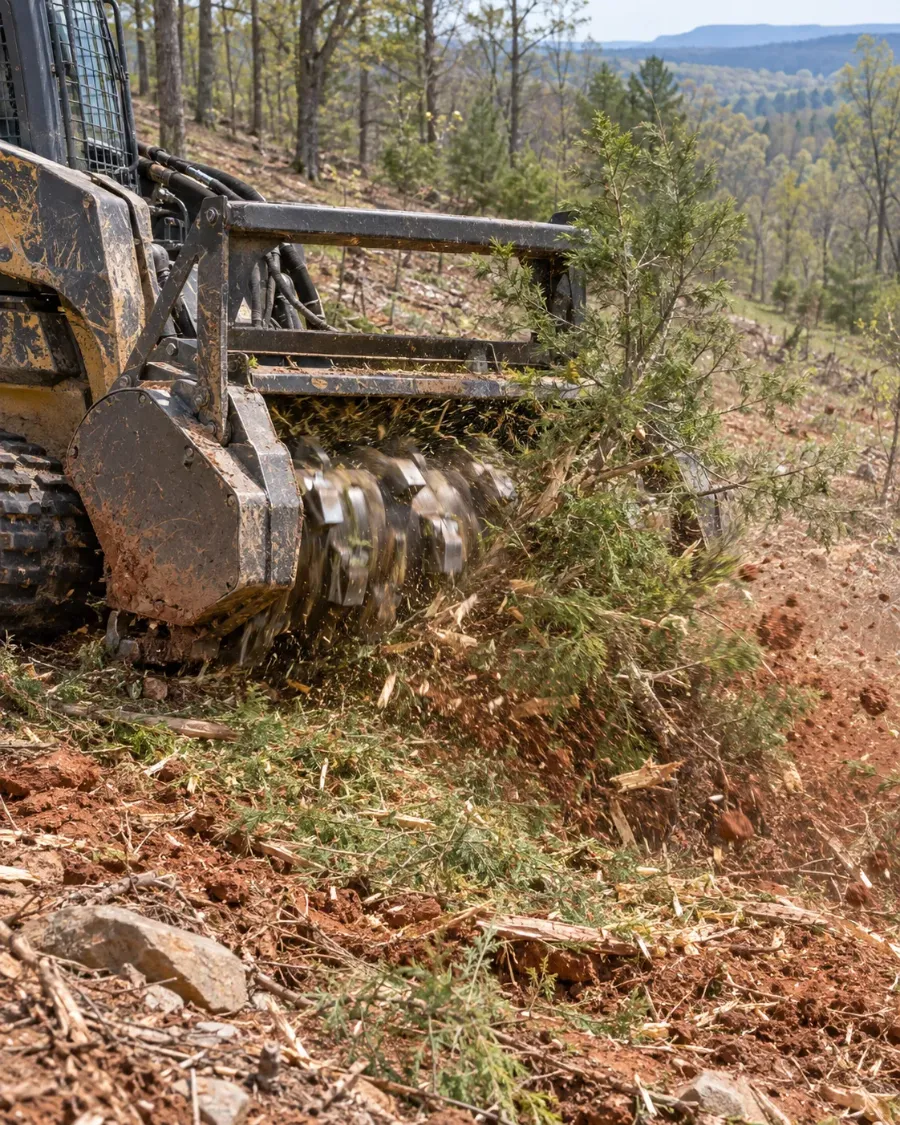
How a forestry mulcher works
The mulching head is a heavy rotating drum (or, on some machines, a disc) fitted with steel or carbide teeth. It rides on the front of a skid steer or compact track loader, on the arm of an excavator, or on a purpose-built tracked carrier. The operator drives into standing growth and the head grinds it from the top down into chips that fall in place as a mulch layer. There's no crew felling trees ahead of it, no burn piles, no chipper, and no trucks hauling brush. One operator, one machine, one pass.
Size limits depend on the machine. Virginia Cooperative Extension's guide to clearing woodland puts the practical ceiling for most mulching heads at stems about 6 to 8 inches across. A head on a standard skid steer handles less; big heads on high-flow loaders or dedicated carriers take more, at a higher hourly rate. Larger trees are usually cut with a saw and then mulched, or the area is handled as conventional clearing. Ask any contractor what diameter their machine handles comfortably, because the answers vary a lot.
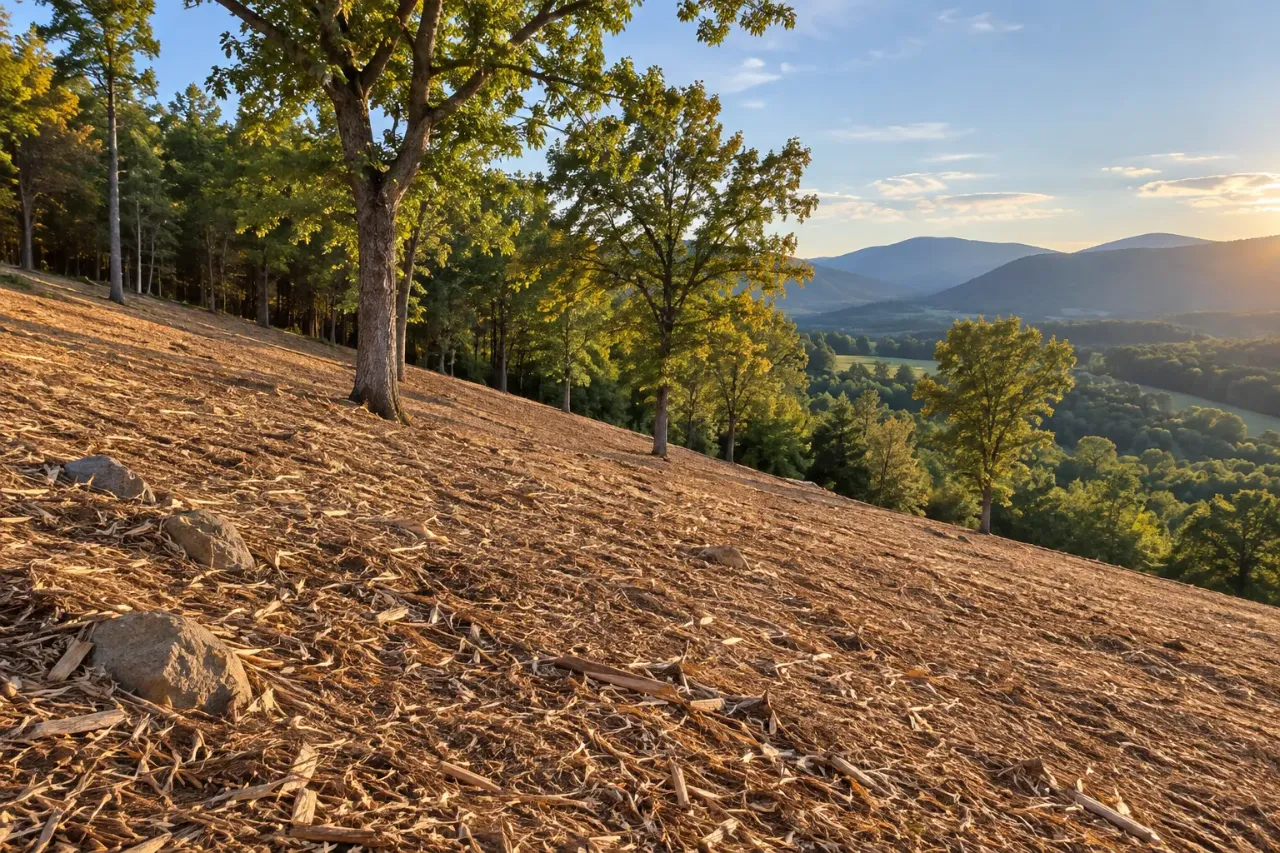
What the land looks like afterward
- A layer of mulch, deep where the growth was thick and thin where it wasn't. The chips break down over roughly a year or so, and while they decompose they tie up nitrogen at the surface, which is why grass seeded into deep mulch often struggles.
- Stumps cut low, roots left alone. The head can grind stumps close to the ground, but the root systems stay put. You can mow over them in a pasture; you can't build on them.
- Soil left in place. Nothing is pulled out, so there are no stump holes, and the topsoil stays where it was. Extension describes mulching as the lowest-erosion way to clear, which counts for a lot on Albemarle hillsides and red clay.
- The trees you chose to keep. An operator can work around individual oaks, dogwoods, or a tree line without digging into their roots, which an excavator grubbing stumps can't promise.
Typical mulching jobs around Charlottesville
A lot of Albemarle is former farmland and old orchard, and a field left alone here fills in quickly with eastern red cedar, Virginia pine, sweetgum, autumn olive, multiflora rose, and briars. That's exactly the growth a mulcher handles best. Common jobs:
- Taking a pasture or hayfield back from cedar and scrub.
- Opening a view from the house toward the Blue Ridge or across a valley, selectively. (More on view clearing.)
- Clearing fence lines and field edges so a tractor can get back in.
- Cutting walking, riding, or ATV trails through the woods.
- Thinning the understory of a woodlot while leaving the large trees.
- Clearing most of a wooded homesite before only the house, drive, and drainfield footprint is grubbed.
- Knocking back an old orchard or a thicket of invasive shrubs.
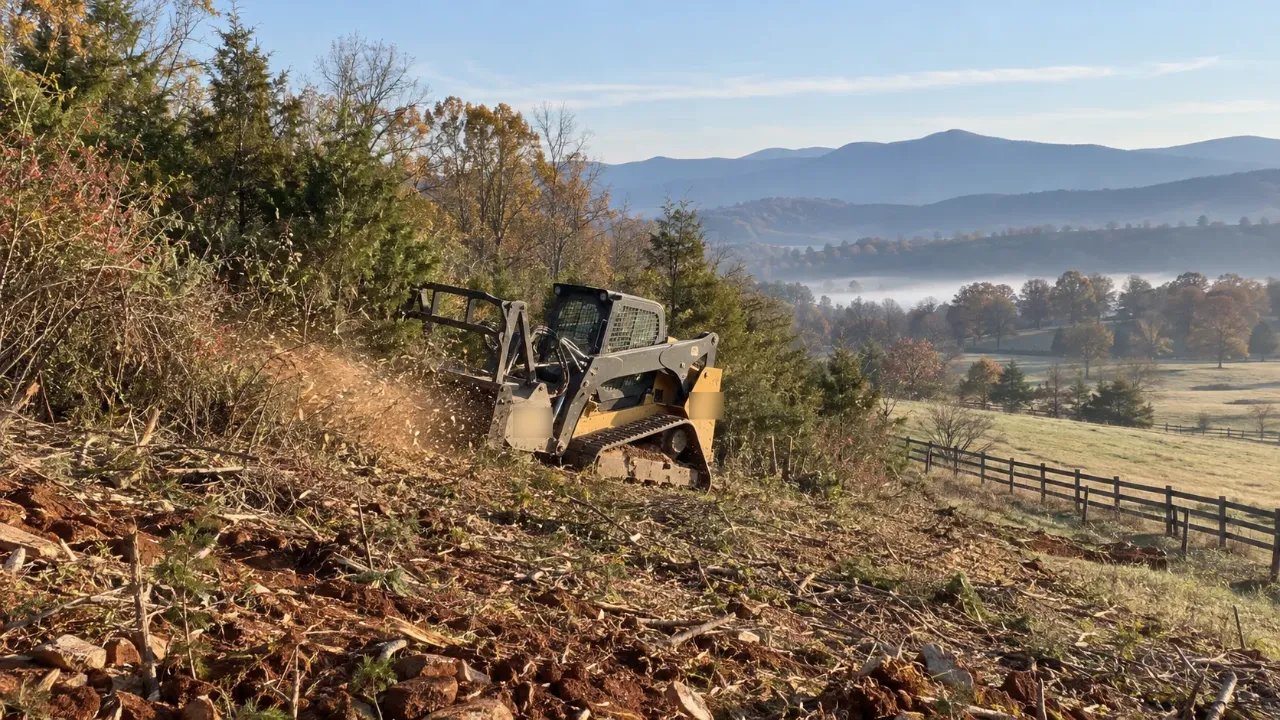
Extension's rule of thumb is anywhere from one to eight hours of machine time per acre, depending on how thick the growth is. A field of scattered cedar goes fast; a solid stand of 6-inch sweetgum on a hillside doesn't.
When mulching is the wrong tool
- Anywhere you'll build. Roots left in the ground rot, and the ground settles. A house pad, driveway base, barn, or septic drainfield needs stumps and roots grubbed out and the ground graded. Mulch the acreage; grub the footprint.
- Big timber. Mature oak, poplar, and pine are beyond a mulcher. They're cut, and on a larger stand may be worth selling to a logger first.
- Very steep ground. Tracked mulchers have slope limits; a U.S. Forest Service equipment trial reported a contractor maximum around 25 percent. In the foothills west and north of Charlottesville, the steepest pitches may need hand crews or may be better left wooded, and slopes that steep can also come with county rules. The permits guide covers that.
- Rocky ground. Rock wears out teeth quickly, and the contractor will price it in once they've seen it.
- Wet ground. Running heavy equipment on saturated clay compacts it and leaves ruts. Expect a contractor to wait for a dry stretch.
- Inside a stream buffer. Albemarle requires native vegetation to stay within 100 feet of most streams, with exceptions for dead or diseased trees, hazards, and invasive plants. Walk the property with the contractor and agree where the work stops.
- When you need bare soil right away. Deep mulch has to be raked off or allowed to break down before seed will take.
Plan for what grows back
Mulching cuts trees; it doesn't kill most of them. Extension warns that hardwood stumps resprout unless the fresh cut is treated with herbicide promptly. The U.S. Forest Service's species guides describe red maple sprouting within two to six weeks of cutting, sweetgum regenerating from root sprouts, and black locust sprouting from both stump and roots. Cedar and pine don't resprout, which is why a cedar field stays clear longer than a sweetgum one.
In practice, plan on bush-hogging the sprouts in the first year or two, a herbicide follow-up for the worst species, or both. Ask whether the contractor treats stumps as they go and what they'd recommend for what's on your land. The brush and pasture guide covers the species that come back hardest.
What forestry mulching costs
Mulching is quoted per acre, per day, or per machine hour. National guides don't agree: HomeAdvisor's June 2026 figures run $400 to $1,500 per acre and $125 to $400 an hour depending on density, while Angi's May 2026 figures run $1,000 to $2,500 per acre at $150 to $300 an hour. A study cited by Extension found mulching at roughly half the cost of conventional clearing, which is old pricing but a fair picture of the gap.
On Albemarle land, slope, rock, and how far the machine has to travel push the number up; open fields of small cedar push it down. Small jobs carry a minimum because the machine has to be trailered out either way. None of these are Charlottesville quotes. The written quote from a contractor who has walked your land is the number that counts. More on cost.
Does mulching need a permit in Albemarle?
Some contractors say mulching never needs a permit. That's too simple for Albemarle. The county requires a land disturbance permit at 10,000 square feet, and its definition of land disturbance names "clearing" along with grading and excavating. Nothing official we could find says whether mulching that leaves roots in place counts. The county code leaves that call to the County Engineer, so for a job over 10,000 square feet, ask Albemarle Community Development (434-296-5832) before the machine comes.
Other rules apply no matter how small the job. Since September 1, 2026, Albemarle's stream buffer standards require native vegetation to stay within 100 feet of most streams, development or not, and they specifically don't allow removing trees or shrubs just to open a view. Land under a conservation easement may have clearing limits in its deed. On the plus side, mulching avoids Albemarle's strict burn permit entirely, because there's nothing to burn. The permits guide has the details and the numbers to call.
Forestry mulching questions
Is mulching cheaper than bulldozing?
Usually. It's one machine instead of several, and there's nothing to burn or haul. The exception is land you'll build on: mulching it first and then grubbing it means paying twice for the same footprint.
Should I cut the trees down before the mulcher comes?
Generally no. Mulchers work best on standing trees; downed trunks lying in every direction slow the job. Ask the contractor before you pick up a saw.
Can I plant grass right after?
Where the mulch is thin, yes, often after a light disking. Where it's inches deep, seed won't reach soil and the decomposing chips pull nitrogen. Rake the deep spots, give it a season, or ask the operator to make a second pass to grind the chips finer. A soil test will tell you how much lime and fertilizer the field needs.
Will it hurt the trees I'm keeping?
Flag them before the operator shows up. Mulching around a tree leaves its roots alone, but the head can scar bark if the operator works too tight. Agree on how close they'll go.
How many acres a day?
From under an acre to several, depending on what's growing, the slope, and the machine. A good contractor will estimate days, not just dollars.
How we help
Call or send a short request telling us where the land is, roughly how much of it, and what's growing there. We connect you with one independent contractor who runs mulching equipment in your part of Charlottesville or Albemarle. They walk the property and give you a quote, and you decide. There's no charge for the referral.
Want a local contractor to walk your land?
Call or send a short request. There's no charge for the referral.