
Land Clearing Cost in Charlottesville & Albemarle County, VA
What does it cost to clear land around Charlottesville? Anywhere from a few hundred dollars an acre for brush to well over ten thousand for a wooded, sloping house site, and the acreage is rarely what decides it. Tree size, whether stumps come out, how steep and rocky the ground is, and where the debris goes do. Here are the published national figures with their dates, the things that push an Albemarle job up or down, and how to compare quotes that aren't written the same way.
Published price ranges, by type of job
These are published figures from the sources named, with the date each was published. Most are national. One is a Virginia contractor's own price page, and the only Charlottesville-specific estimate we found is from 2022. None of them is a quote for your land, and they don't agree with each other, which is a good reminder of how much the specific property matters.
| Job | Published range | Source |
|---|---|---|
| Lightly wooded land, per acre | $500 to $2,000 | Angi, Sept. 2026 |
| Lightly wooded land, per acre | $1,200 to $2,500 | HomeGuide, Nov. 2025 |
| Densely wooded land, per acre | $3,600 to $5,600 | Angi, Sept. 2026 |
| Heavily wooded land, per acre | $4,500 to $8,000 | HomeGuide, Nov. 2025 |
| Average clearing project | about $3,780 | Angi, Sept. 2026 |
| Professional clearing in Virginia, per acre | $1,500 to $6,500 for most landowners | M.L. Blake Earthworks (Gloucester, VA), 2026 price page |
| Charlottesville estimate, per acre | $2,600 to $4,200 | HomeBlue, March 2022 (older figure) |
| Forestry mulching, per acre | $400 to $1,500 | HomeAdvisor, June 2026 |
| Forestry mulching, per acre | $1,000 to $2,500 | Angi, May 2026 |
| Machine and operator, per hour | $110 to $400, by machine and density | Angi and HomeAdvisor, 2026 |
| Brush clearing, per acre | $330 to $3,000 (guides disagree) | Lawn Love 2025, HomeGuide 2025 |
| Stump grinding | about $250 for a standard job; $2 to $5 per inch of diameter | Angi, Mar. 2026 |
| Stump removal | average $340; most pay $75 to $500 | This Old House, Mar. 2026 |
| Debris hauling | $300 to $1,000 per load; dumpsters $225 to $800 | Angi, 2026 |
What pushes an Albemarle job up or down
- Tree size and density. Still the biggest factor. An old field of cedar and saplings is an afternoon for a mulcher; an acre of mature oak and tulip poplar is a different job with different machines.
- Slope. By our tally of USDA soil survey data for Albemarle, roughly a fifth of the county is mapped on slopes of 25 percent or more. Steep ground slows every machine, limits what a tracked mulcher can safely work, and can mean hand crews on the steepest pitches. Slopes of 25 percent and up also bring county rules for building. The permits guide covers when.
- Rock. Close to a quarter of Albemarle's mapped soils carry "stony," "rocky," or "bouldery" in their names, and some common soils sit on bedrock 10 to 20 inches down. Rock chews up mulcher teeth and grinder wheels and slows grubbing. Contractors price it in once they've seen it.
- Mulch or grub. Leaving stumps and roots in place (mulching) costs far less than pulling them (clearing and grubbing). Virginia Cooperative Extension cites a study putting mulching at about half the cost of conventional clearing.
- Debris. This is where Albemarle differs most from other counties. A county land-clearing burn permit costs $500, requires $1.5 million in liability insurance, and requires piles 2,000 feet from any neighbor's occupied building unless they agree in writing. That rules out burning on many properties, so debris here is often mulched in place, ground, or hauled, and hauling costs the most. In the City of Charlottesville, burning land-clearing debris isn't allowed at all.
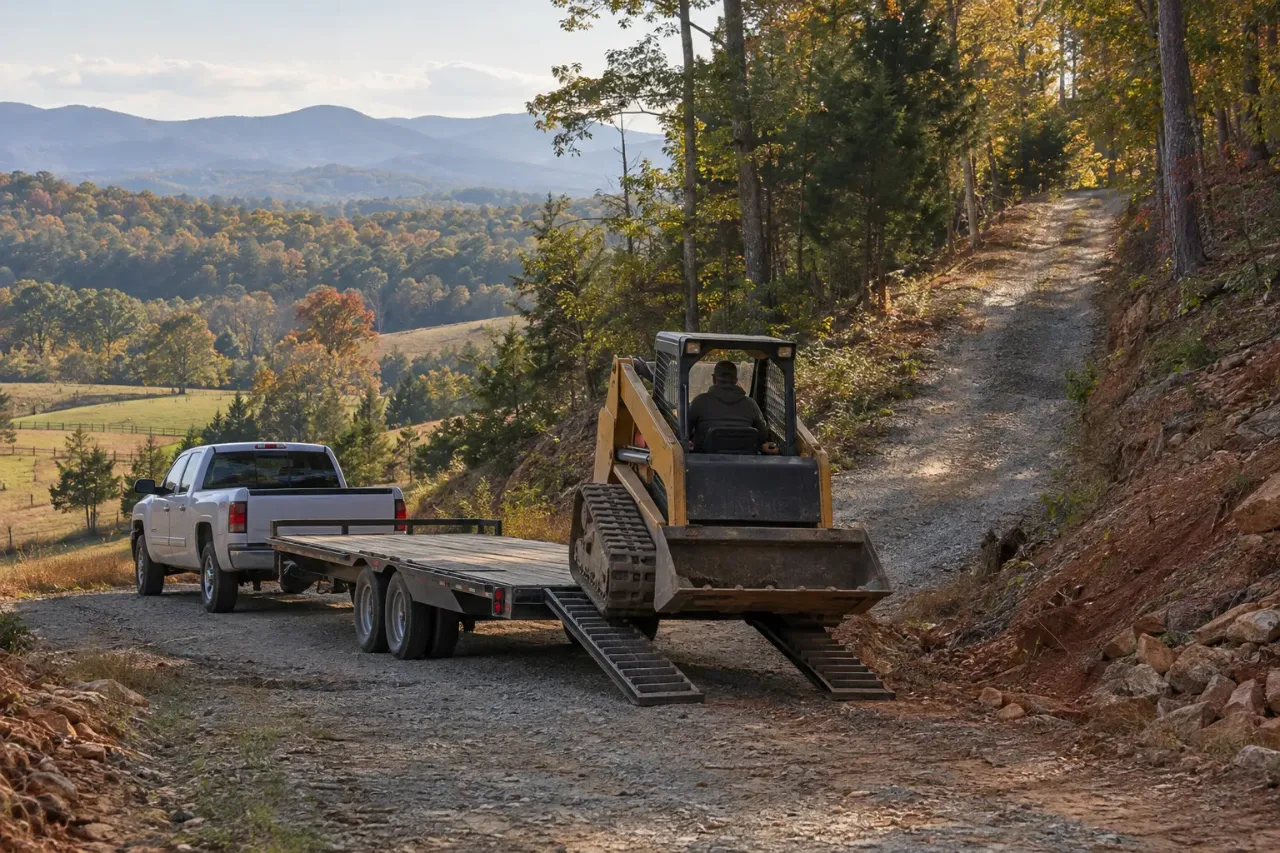
- Access. A long, narrow, or steep farm lane can keep a lowboy trailer from getting a machine close, which means walking it in or cutting a path first.
- Selective work. Clearing for a view, or thinning while keeping specimen trees, is slower than clearing everything, because the operator works around what stays.
- Streams and wet ground. Albemarle's stream buffers keep native vegetation in place 100 feet back from most streams, so the work stops short of the creek. Wet spots slow machines and rut. Both take planning and time.
- County permit fees. If the job disturbs 10,000 square feet or more, Albemarle's plan review and land disturbance permit fee is $235 up to an acre and $2,205 from one to five acres, per the county's fee schedule, plus the silt fence and other erosion controls the plan calls for.
- Acreage. Per-acre rates drop as jobs get bigger, because the cost of getting the machine there is spread out. A half-acre job can cost nearly what a two-acre job does.
- Finish work. Rough grading, topsoil, seed and straw, and erosion controls are real costs and are often quoted separately from the clearing.
Per acre, per day, or per hour?
You'll see all three. A per-acre price is easy to compare but depends on each contractor's read of how thick the growth is, so two per-acre numbers can assume different work. A day rate for a machine and operator puts the risk on you: if the woods are denser than they looked, that's another day. An hourly rate is fairest for small or uncertain jobs and hardest to budget.
Ask every contractor for the same two things: an estimate of machine days, and a written list of what's included. "Clear 3 acres, $7,500" and "Mulch 3 acres, grind stumps flush, 2 days, $6,000, extra days $2,500" can't be compared until you know whether the first one includes the stumps.
What a written quote should spell out
- The area, shown on a map or staked on the ground, and what's left out: keeper trees, the drainfield site, stream buffers, steep ground.
- The method: mulching, cutting and grubbing, or both, and where each applies.
- Stumps: left, ground flush, ground below grade, or dug out, and to what depth.
- Debris: burned, ground, buried, or hauled, and who gets any burn permit.
- Timber: who keeps the logs and firewood, and whether any value is credited.
- Grading, topsoil, seeding, and erosion controls, each marked in or out.
- Expected days on site, the rate for extra days, and what happens if weather stops work.
- Who calls Virginia 811, and who handles the county land disturbance paperwork if it's needed.
- The contractor's license number and classification and proof of liability insurance. DPOR's consumer guidance suggests a deposit of no more than 10 percent or $1,000, whichever is less, and never paying in full before the work is done. More on hiring.
Ways to bring the cost down
- Mulch the acreage and grub only the footprint of the house, drive, and drainfield. It's the most common way to cut a house-site bill.
- Sell merchantable timber first if there's a real stand of it. Small lots rarely qualify. The Virginia Department of Forestry says never to sell timber on a verbal agreement.
- Mulch the debris instead of hauling it where you can. In most of Albemarle, burning isn't practical because of the county's setbacks and insurance requirement.
- Keep the firewood. Cut and stacked hardwood is worth something to you even when it isn't worth anything to a logger.
- Leave the stumps you'll never need gone, along a wood edge or in a pasture you'll only mow.
- Split the trip with a neighbor. A machine already on your road costs less to bring next door.
- Wait for dry ground. Clay that's wet is slow, rutted, and messy to put back.
Cost questions
How much does it cost to clear an acre near Charlottesville?
Using the national guides above, roughly $500 to $2,500 for light growth, several thousand for dense woods, and more on steep or rocky ground or where stumps and debris are removed. Forestry mulching usually falls toward the low end. Those aren't local quotes; a contractor who walks your acre will give you the real number.
Is there a minimum charge?
Nearly always. Moving a machine costs the same whether it works an hour or a day, so expect a half-day or full-day minimum for mulching and a trip minimum for stump grinding, especially on properties well outside town.
Why are two quotes for the same land thousands apart?
Usually they describe different jobs. One grubs and hauls; the other mulches and leaves the stumps. Put them side by side line by line before comparing the totals.
Will the timber pay for the clearing?
On larger tracts with good hardwood or pine, it can offset some of it. On a typical house lot the trees are too few or too scattered to interest a logger, and the clearing is a cost, not a sale.
Should I rent a machine and do it myself?
HomeAdvisor lists skid steer and mulching head rentals at roughly $1,200 to $3,000 a day in 2026. An experienced operator gets far more done in that day than a first-timer, and on sloped ground the learning curve is a safety issue. The permits, the 811 call, and the erosion rules apply to you either way. For light brush it can make sense; for real clearing it rarely does.
How we help
Call or send a short request. We connect you with one independent contractor who works in your part of Charlottesville or Albemarle County. They walk the land and give you a written quote, and you decide. There's no charge for the referral.
Want a local contractor to walk your land?
Call or send a short request. There's no charge for the referral.